


14C dating ECHoMICADAS
ECHoMICADAS - Environnement Climat et Homme « Micro Carbon Dating System »
This email address is being protected from spambots. You need JavaScript enabled to view it.
ECHoMICADAS (Environment, Climate, Human, Micro CArbon DAting System) is an accelerator low energy coupled with an ultra-compacted mass spectrometer, allowing to analyze high precision isotopic 14C/12C ratios for gas or graphite samples. This instrument is dedicated to research activities, development and training, in geochemical and geochronological 14C activities, especially in environmental and human sciences.
ECHoMICADAS has been acquired in partnership with three laboratories : Laboratoire des Sciences du Climat et de l’Environnement (LSCE/IPSL), Laboratoire Géosciences Paris-Sud (GEOPS/IPSL) and the UMR 7209 « Archéozoologie Archéobotanique: sociétés, pratiques et environnements ». It is financed by the DIM Analytics (Région île de France), FEDER, BNP Paribas, Labex BCDiv and the administrative authorities of the laboratories (CEA, CNRS, MNHN, Paris XI).
The three associated research laboratories have the expertise to process all types of samples. They use extraction lines to convert the carbon of a sample in CO2 and reduction lines to graphitize these samples.
Contacts:
LSCE
Christine Hatté 01 69 08 00 52 - This email address is being protected from spambots. You need JavaScript enabled to view it.
Nadine Tisnérat-Laborde 01 69 08 04 21 - This email address is being protected from spambots. You need JavaScript enabled to view it.
François Thil 01 69 08 04 22 / 01 69 08 38 70 - This email address is being protected from spambots. You need JavaScript enabled to view it.
GEOPS
Marc Massault 01.69.15.49.18 - This email address is being protected from spambots. You need JavaScript enabled to view it.
Giuseppe Siani 01.69.15.67.89 – This email address is being protected from spambots. You need JavaScript enabled to view it.
UMR 7209
Antoine Zazzo 01.40.79.33.13 - This email address is being protected from spambots. You need JavaScript enabled to view it.
Olivier Tombret 01.40.79.46.82 - This email address is being protected from spambots. You need JavaScript enabled to view it.
Quantitative analysis of major and trace elements in various materials (waters, carbonates, sediments, rocks, etc). Pb isotope measurements and U / Th dating (carbonates-apatites)
Inductively Coupled Plasma – Quadrupole Mass Spectrometer - ICP-QMS X-seriesII CCT
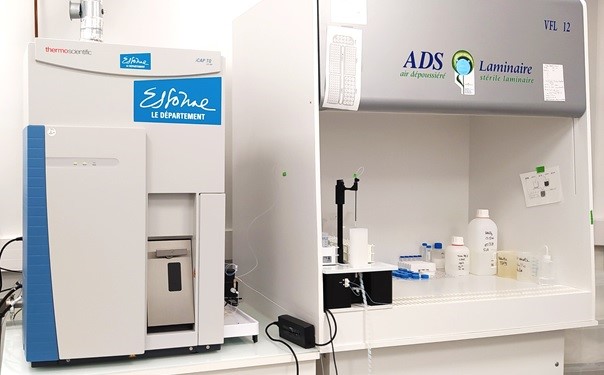
Characteristics of Instrumentation:
The Inductively Coupled Plasma – Quadrupole Mass Spectrometer (ICP-QMS) X-series II CCT Thermo Fisher Scientific is dedicated to quantitative multi-element analysis. This instrument allows rapid (~ minute), precise (~ percent) and quasi-simultaneous determination of the content of many chemical elements of the Periodic Table from the majors to those present in trace amounts in natural samples (freshwater, seawater, plants, soils, carbonates, apatites, rocks, etc.) or for any other type of materials or solutions. In its basic configuration, this mass spectrometer offers detection limits lower than μg / L (ppb) for many elements in solution and can reach several 100 pg / L (ppq) for heavy elements such as Rare Earth Elements or Uranium. Two options improve its performance: i- the CCT collision cell eliminates polyatomic interferences, typically for elementary analysis with atomic mass between 40 and 80 (transition metals, metalloids such as As, Se) ; ii- an additional pumping called “option S” at the interface lowering the detection limit for some heavy elements (uranium) to a few pg / L.
Three major application domains are currently being developed at the LSCE: i- elementary or isotopic (Pb) characterization of samples dissolved in solution to trace erosion processes, study of particle mobility as well as determine their origins, and quantitatively monitor the dissemination of some heavy or toxic metals in the environment, particularly in urban environments ; ii- elementary characterization of marine or continental carbonates/apatite archives (corals, foraminifera, speleothems, teeth, etc.) for paleoceanography, climatology or archeological studies (marine geochemistry, ocean temperature, carbon cycle and ocean acidification, precipitation, etc.) ; and iii- U-series Geochronology and U-Th dating of carbonates (corals) or apatites (teeth).
Principle of Measurement:
The principle is based on dissociation of molecules, atomization and ionization of the elements present in a solution and injected into a "Plasma" source of argon at 6000-8000 °K and atmospheric pressure. After the formation of an ion beam via the interface (sampler and skimmer cones) during a progressive transition to a secondary vacuum, a Quadrupole separates the isotopes or ions at low resolution according the m/z ratio. The ions/isotopes are then detected by a discrete-dynode electron multiplier. The precise quantification of the contents of major and / or trace elements is obtained after calibration of the instrumentation (standard solutions known or certified). Depending on the matrix or nature of the samples analyzed, the elements studied and the degree of precision sought, different calibration methods are used (standard calibration curves, standard addition or matrix recomposition methods, “bracketing” approach).
Other informations
- Nebulizers : PFA 20, 50 or 100 µL/min ; quartz 1 mL/mn (solutions);
- Quartz micro-cyclonic spray chamber or conic chamber with impact bead (solutions);
- Desolvating systems APEX HF (2 à 10-fold more sensitive, solutions) ;
- Ablation laser Excimer ESI – NWR 193 nm (in-situ analysis, aerosols from solid materials).
Measurements performed by ICP-QMS:
-
Quantification of major and/or trace elements in waters, soils, rocks, carbonates (erosion / transfer of particles) ;
-
Relative measurement of Pb isotopes (source tracing) ;
-
Quantification of majors (Sr/Ca, Mg/Ca) and trace elements (Li/Mg; B/Ca; Ba/Ca, U/Ca, REE, etc.) present in carbonates like corals or speleothems (paleoceanography / climatology / carbon cycle) ;
-
Quantification of rare earths and other elements present as ultra-traces in seawater or sediments (characterization of materials or processes) ;
-
Relative measurement of U and Th isotopes for U-Th dating of corals, speleothems, teeth.
Contacts:
Delphine Thomas : This email address is being protected from spambots. You need JavaScript enabled to view it. 01 69 08 33 77
Sophie Ayrault : This email address is being protected from spambots. You need JavaScript enabled to view it. 01 69 08 40 71
Eric Douville : This email address is being protected from spambots. You need JavaScript enabled to view it. 01 69 08 22 57