


Analyses of magnetic properties and magnetostratigraphy on u-channels (IRM and S-ratio)
Cryogenic magnetometer with helium equipped with high resolution pick-up coils designed for measurements on u-channel type samples (2G Enterprises)
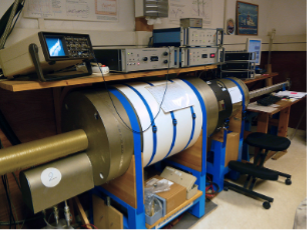
Instrument description:
Helium-free cryogenic magnetometer dedicated to the high resolution (4.5 cm) measurement of Isothermal Remanent Magnetization (IRM) on continuous series (maximum square section of 22 mm, maximum length of 1.5 m). Three alternating field (AF) coils are installed in line for stepwise demagnetization, as well as one solenoid for ARM acquisition. The system is placed in the µmetal shielded room.
Principle of the analysis:
The remanent magnetization is measured along the 3 axes X, Y, Z with high resolution pick-up coils. The magnetizations can be demagnetized along the three axes by alternating field up to 100 mT. Stepwise acquisition of IRM can also be performed as well as its stepwise AF demagnetization. The entire procedure is controlled using a dedicated software.
Analyses performed with the instrument:
-
Measurement of isothermal remanent magnetizations (IRM) on continuous series
-
Stepwise AF demagnetization
Contact:
Gwenaël Hervé : 01.69.08.02.48 / This email address is being protected from spambots. You need JavaScript enabled to view it.
Gamma-ray spectrometry analysis of natural radio-isotopes (U-238, Th-232, ...) and artificial (Cs-137, Am-241, Co-60, ...)
Low Background gamma spectrometer
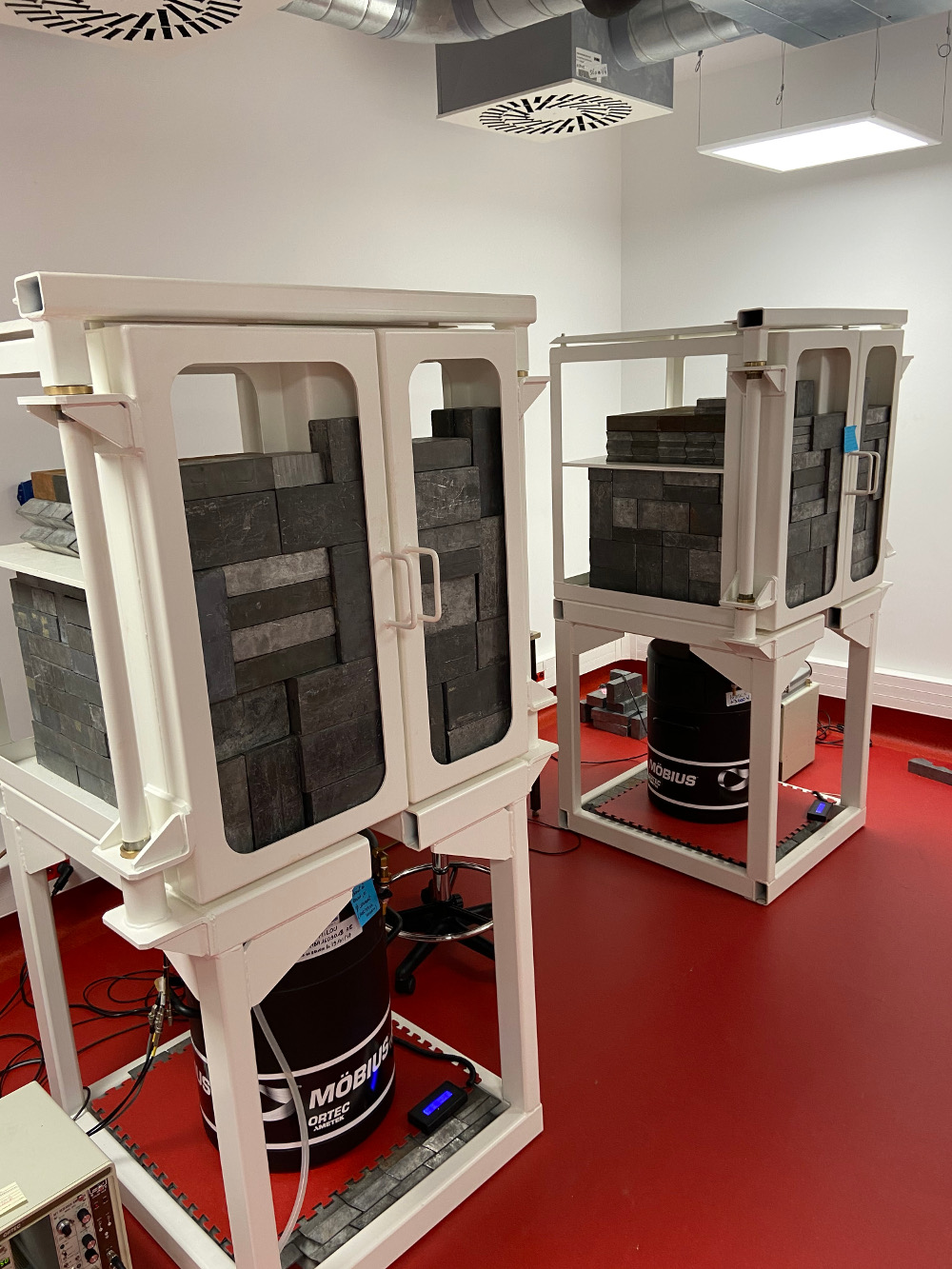
View of part of the LSCE gamma detectors
Description of instrument:
Gamma spectrometry is a direct and non-destructive measurement technique.
Soil or sediment samples should simply be dried in an oven, crushed and sieved. The samples are then packaged in standardized boxes and placed on a gamma detector.
At the LSCE, the detectors are crystals of hyperpure germanium (N or P type) cooled with liquid nitrogen. The gamma photons produced by the disintegration of the radioisotopes present in the sample arrive on the germanium crystal and are converted into electrical signals. These signals are amplified, identified by an encoder and then stored in a multichannel analyzer that classifies and totalizes the number of photons emitted according to their energy.
A gamma spectrum is obtained in which each energy line is characteristic of a radioisotope and the area of each peak is proportional to the amount of these radioisotopes in the sample.
In order to protect the detectors against the ambient radioactivity generated in particular by cosmic rays and atmospheric radon, these are installed in the basements of the laboratory (L'Orme des Merisiers site - 6 detectors in service) or even under 1700 meters of rock in the Alps (site of Modane - 3 detectors operated by the LSCE).
Moreover, They are protected by lead, iron and copper shielding that reaches a thickness of 15 to 20 cm.
Principle of analysis:
Radioactive isotopes (or radioisotopes) are unstable elements whose radioactivity decreases over time. Each radioisotope is characterized by a half-life period which is a constant and which corresponds to the time required for half of the present atoms to disintegrate. The use of radioactive markers in the study of soil erosion processes dates back to the 1960s, with the advent of the nuclear age. The soil has a natural radioactivity due to the presence of certain chemical elements (typically uranium, thorium and potassium). It is also subjected to the flow of radioactive isotopes produced or released in the upper atmosphere and which eventually fall back to the ground. Some of these radioisotopes are natural (such as beryllium-7) and are called "cosmogenic". Others are said to be artificial (such as cesium-137) because they have been introduced into the atmosphere as a result of nuclear tests and incidents that affected nuclear power plants in the second half of the 20th century.
Of all the radioactive isotopes present in the environment, there are only a few that can be used as "markers" for displacements of soil particles. These radioisotopes must have a high chemical affinity for soil particles and must have a relevant half-life for studying the studied processes. Radioisotopes can emit different types of radiation (alpha, beta or gamma). Gamma emitters are generally preferred, for their ease of detection and analysis. Indeed, no prior chemical separation of the soil samples is required.
Analyzes carried out:
- The natural radioisotopes of the U-238 chain (Th-234 / Ra-226) including Pb-210 and Th-232 (Th-228 / Ra-228) and K-40, Be-7
- Artificial radioisotopes such as Cs-137; Am-241, Co-60
Matrices: dry solids (oven drying or lyophilization) and sieved to 2 mm.
Contacts:
Irène Lefèvre : This email address is being protected from spambots. You need JavaScript enabled to view it.
Olivier Evrard : This email address is being protected from spambots. You need JavaScript enabled to view it.