Simultaneous analysis of DIC and δ13C in small volumes of natural, fresh and marine waters
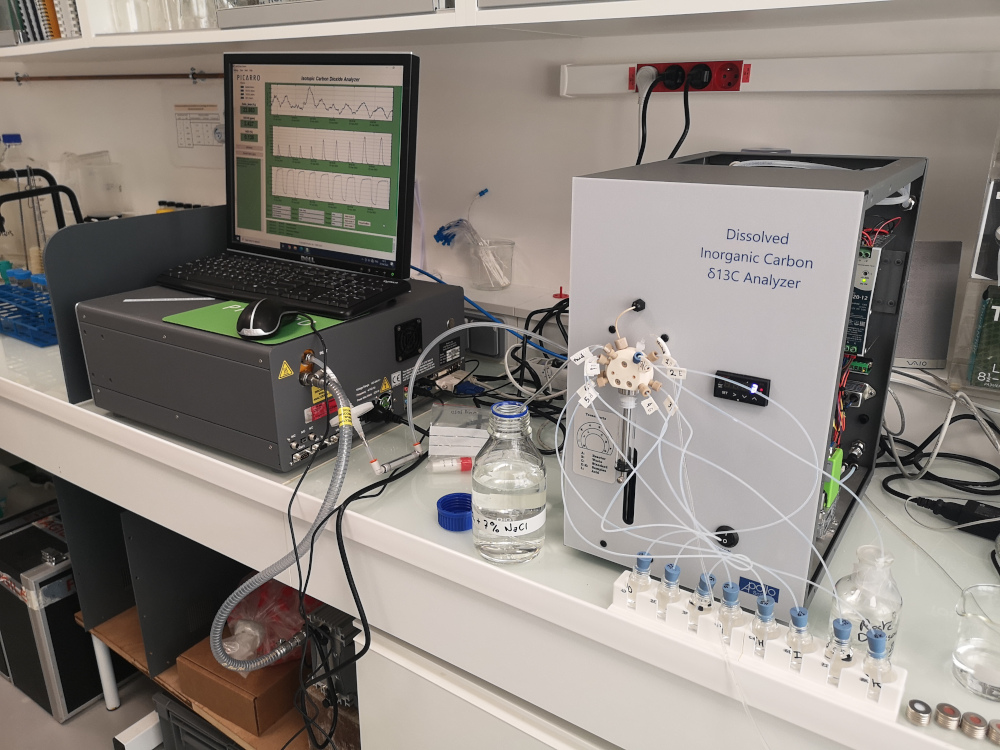
AS-D1 from Apollo SciTech
Instrument description
The AS-D1 analyser, marketed by instrumentation company Apollo SciTech, is a device coupling liquid sample injectors, gas separators and simultaneous Picarro CRDS measurements of CO2 and 13Ccontent with accuracies of ±2 µmol/L for DIC and ±0.1‰ for δ13C. This coupling of instruments minimises sample handling (no gas separation) minimising contamination and sample loss.
Principle of analysis
The AS-D1 analyser enables simultaneous analysis of DIC and δ13C with precision and in small sample volumes of fresh or marine waters, in the millilitre range. Depending on the volume of sample available but the injection can range from 0.75 ml to 4 ml. At most, 3 samples are taken (injection by automatic syringe). The sample is injected into the reaction cell, surrounded by two volumes of H3PO4 (3% H3PO4 in 7% NaCl), where it is mixed. In the reaction cell, the sample + H3PO4 is mixed and the DIC is converted into CO2, which is sent via a flow of dry air (drierite - calcium sulphate filter) and CO2-free air (ascarite filter), into a Picarro analyser (CRDS). The analysis takes about 12 minutes per injection. The DIC is calibrated using certified seawater (Certified Reference Materials Laboratory, Professor Andrew G. Dickson, Scripps Institution of Oceanography, University of California, San Diego, This email address is being protected from spambots. You need JavaScript enabled to view it.) and the δ13C calibration is currently being validated.
Analyses performed on the instrument
DIC and δ13C
Contacts
Bruno Bombled : This email address is being protected from spambots. You need JavaScript enabled to view it.
Funding
UVSQ for the Apollo analyzer part and CEA For the Picarro part
Alkalinity measurements and acid-base kinetics
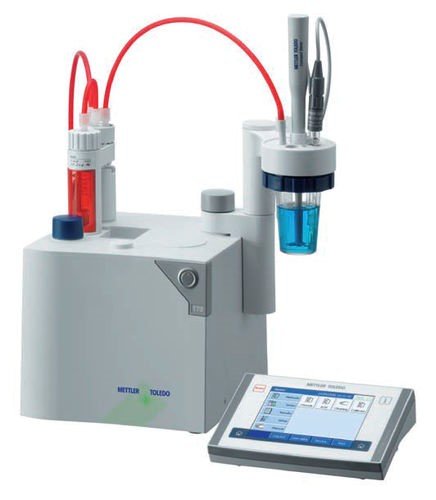
Mettler Toledo T5 Excellence
Potentiometric titrator for carbonate and bicarbonate analysis (alkalinity) or acid-base kinetics
Instrument description
The potentiometric titrator (Mettler Toledo T5 Excellence) allows to measure the concentrations of carbonate and bicarbonate ions in natural waters. It also measures the kinetics of acid-base equilibria.
Principle of analysis
A liquid sample (of known volume) is introduced into a beaker. A magnetic bar stirs the solution (a colored indicator can be added). A precision syringe adds an acid or base of known concentration to the solution. When the addition of acid or base causes the pH to vary, the instrument measures the inflection points of the pH curves. For alkalinity, around pH=8.3 is the first equivalence point which corresponds to the transformation of carbonate ions into bicarbonate ions, then a second equivalence point corresponding to the transformation of bicarbonate ions into carbonic acid around of pH=4.3. It gives the alkalinity of the sample.
See principle of measurement here: https://chimieanalytique.com/potentiometrie/
Analyses performed on the instrument
- Carbonate (CO32-) and bicarbonate (HCO3-) ions for alkalinity measurement with an accuracy of +/- 5%, 20 mL minimum sample for analysis.
Contacts
Gaël Monvoisin : 01.69.15.71.74 / This email address is being protected from spambots. You need JavaScript enabled to view it.
Fundings
OSUPS Sciences of the Univers Observatory of university Paris-Saclay: Year 2020.