Analyzes of the concentration of major anions in solution
Dionex ICS 1000
Ionic Chromatography for anion concentrations analysis (F-, Cl-, NO2-, Br-, NO3-, PO43-, SO42-)
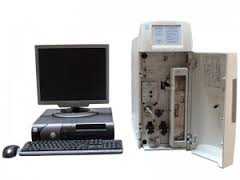
Description of instrument:
Ionic chromatography (Dionex ICS 1000) measures the anion concentrations of solutions. The separation of anions can be done on different columns depending on the matrix and ions of interest.
Principle of analysis:
A liquid sample (filtered) is introduced, from the autosampler, into an injection loop, then through a column separating the ions which arrive, one after the other, separated by the column, on a detection cell (here conductimetry). The concentration of the anions is determined in relation to a previously established calibration range.
See measurement principle here :
Analyzes carried out on the instrument:
Major anions (F-, Cl-, NO2-, Br-, NO3-, PO43-, SO42-) between 0.05 and 100 ppm depending on the elements with an accuracy of +/- 5%, only on liquid solutions (filtered).
Contacts:
Gaël Monvoisin : +33 (0)1.69.15.71.74 / This email address is being protected from spambots. You need JavaScript enabled to view it.
Fundings:
University Paris-Sud: Year 2005
Analyzes of major cations and metallic elements concentrations in water and sediments or rocks
Agilent Technologies AAS 240 FS and GTA 120
Flame or Graphite Furnace Atomic Absorption Spectrometer to analyze cation concentrations (Al, As, Ba, Ca, Cr, Co, Cu, Fe, K, Li, Mg, Mn, Mo, Na, Ni, Pb, Pt, Sb, Sn, Sr, Zn)
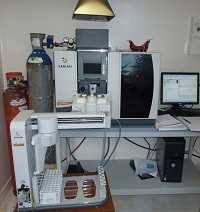
Description of the instrument
The Atomic Absorption Spectrometer (Agilent Technologies AAS 240 FS and GTA 120) can measure the concentrations of many elements. Depending on the concentrations of the solutions, it can be used in flame mode or in graphite furnace mode. It is equipped with automatic diluters (flame/oven) and autosamplers (flame/oven).
Principle of analysis
A liquid sample is injected as a mist into a flame (in flame mode) or a drop is placed in a graphite furnace (in graphite furnace mode). The heat vaporizes the elements contained in the sample and excites their atoms. These disrupt a light signal by reducing its intensity (absorption) or by emitting photons (emission). The light emitted by a hollow cathode lamp(s) or by the electrons of the excited atoms is sent via a set of mirrors and a crystal lattice to a detector which performs an optical measurement of the signal compared to a signal of undisturbed reference. The difference in light intensity is proportional to the concentration of the element in the solution. Calibration is done by injecting a standard solution to obtain the appropriate range. See principle of measurement here: http://spin.mines-stetienne.fr/sites/default/files/specatom.pdf
Analyzes carried out on the instrument
- Major cations (Ca, Mg, Na and K) between 0.05 and 100 ppm in flame with an accuracy of +/- 5%;
- Metals (Al, As, Ba, Cr, Co, Cu, Fe, Li, Mn, Mo, Ni, Pb, Pt, Sb, Sn, Sr, Zn) between 0.01 and 1000 ppm in flame depending on the elements and a few tens of ppt to a few tens of ppb in graphite furnace mode for some elements with an accuracy of +/- 5%;
- Only liquid solutions (filtered and acidified) are analyzed but it is possible to measure solutions of acid attack on rocks, sediments or other solid samples.
Contacts
Gaël Monvoisin : + 33 (0)1.69.15.71.74 / This email address is being protected from spambots. You need JavaScript enabled to view it.
Fundings
CNRS – INSU / University Paris-Sud : AAS flame Year 2010 – AAS graphite furnace Year 2012